
Popularity Creates a Bigger Target
What This Image Is Really Saying
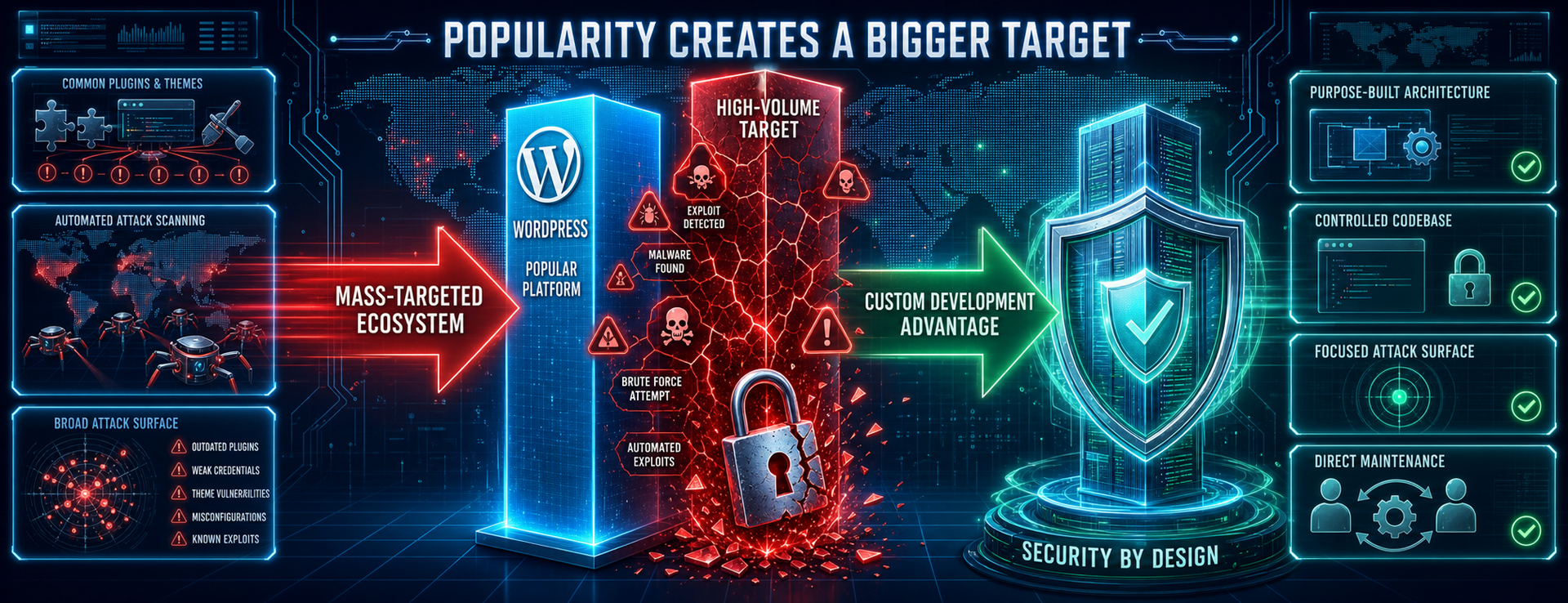
Imagine the most popular kid's locker at school — the one everyone knows the combination to because so many people have used it, shared it, and passed the code around over the years. Because so many people have access to it, it becomes the easiest locker in the whole school to break into, even if the lock itself looks strong. That's exactly what this image is explaining about WordPress, one of the most widely used website platforms in the entire world.
- WordPress is used by an enormous number of websites across the globe, and that popularity is exactly why it becomes such an attractive target for hackers. When something is used by millions of websites, hackers only need to find one weakness, and suddenly they can attack thousands of websites at once instead of just one.
- Thousands of developers use WordPress because it's free and easy to get started with. It doesn't cost anything to download, and there are countless tutorials, templates, and pre-built tools available, which makes it tempting for beginners and even experienced developers who want to build something quickly without starting from scratch.
- But here's the tradeoff: because it's free, easy, and open for anyone to build on, it also becomes a massive, mass-targeted ecosystem for cybercriminals. The image shows automated attack scanning, which means hackers use robots (called bots) that constantly scan the internet 24/7 looking for WordPress websites with weaknesses they can exploit.
- The image lists real threats that happen constantly on WordPress sites: exploit detection, malware infections, brute force attempts (where hackers try to guess passwords over and over), and automated exploits that take advantage of known weaknesses in the platform.
The Hidden Risk of Plug-Ins
One of the biggest reasons WordPress becomes vulnerable has to do with something called plug-ins, and this part is really important to understand.
- Plug-ins are like little add-on tools that give a WordPress website extra features — things like contact forms, photo galleries, security tools, or e-commerce shopping carts. Instead of building these features from scratch, WordsPress users simply install a plug-in someone else already built.
- Here's the problem: these plug-ins aren't created by WordPress itself. They're built by thousands of different independent developers all around the world, many of whom you've never heard of and have no way of verifying. Some are skilled professionals, but many are hobbyists, and some may not follow strong security practices at all.
- When a website uses multiple plug-ins, it's essentially handing over pieces of control of its back-end security to multiple strangers. If even one of those plug-in developers makes a coding mistake, forgets to update their software, or stops maintaining it altogether, that single weak link can become an open door for hackers to break into the entire website — even if everything else on the site is perfectly secure.
- This is exactly what the image means by "Common Plugins & Themes" leading to a broad attack surface. The more plug-ins and themes a website uses, the more entry points a hacker has to try to break in, kind of like a house with dozens of doors instead of just one strong, well-built front door.
The Custom Development Advantage
On the right side of the image, everything changes. Instead of a cracked, vulnerable tower, we see a strong shield labeled "Security by Design," and this represents a completely different approach to building websites.
- We do not build websites on WordPress, Joomla, or any other free, publicly downloadable platform. Instead, we've spent over 30 years developing our own proprietary Content Management System, built entirely from our own code, from the ground up.
- This means our platform isn't part of that massive, mass-targeted ecosystem that hackers scan for constantly. Since we didn't download free software that thousands of other websites also use, hackers can't rely on known weaknesses or common vulnerabilities to break in, because our code isn't publicly available for anyone to study, test, or exploit.
- We control every single piece of the code ourselves — there are no outside plug-in developers involved. Unlike WordPress, where dozens of unknown developers each control a small piece of a website's security, our custom-built platform is developed, maintained, and secured entirely in-house by our own team.
- This is what the image calls a "focused attack surface." Instead of having dozens of potential doors for hackers to try to open (like plug-ins and themes), our proprietary system has a much smaller, tightly controlled structure, making it significantly harder to find any weaknesses to exploit in the first place.
- When security issues do happen on our platform, they are almost always the result of weak passwords chosen by our own customers — not because of an insecure hosting environment or vulnerable code. This is a critical difference. A weak password is something a business can fix instantly by choosing a stronger one, but a vulnerability baked into a mass-used platform's core code or a risky third-party plug-in is a much deeper, harder-to-control problem.
- This is exactly why we practice what the image calls "Purpose-Built Architecture," "Controlled Codebase," and "Direct Maintenance." Everything about our system is built specifically for security from the very beginning, not pieced together from free downloads created by thousands of unrelated developers.